

• Jann de Waal
  • CLICKNL CONTINUES THE MOVEMENT

    CLICKNL would like to thank Paul Hekkert, Barbera Wolfensberger, and Jann C de Waal for their tremendous efforts. Although the Top Team is disbanding, CLICKNL will continue its work as a TKI (Top Consortium for Knowledge and Innovation).

    In this article: an interview with Jann de Waal.

The drive and passion of Jann de Waal

Jann de Waal has been a member of the Top Team since 2016 and has served as Chair of the Creative Industries Top Sector since 2019.
This conversation reflects on the visible, less visible and invisible achievements of the Top Team, the deployment of missing links, and the positioning of the right actors in strengthening the Dutch creative economy, in which design capacity plays a crucial role.

With a compact ecosystem, we have been able to set things in motion in a sustainable way and anchor them structurally.

Jann de Waal has always been an active and committed figure. In 2016, Barbera Wolfensberger asked him to succeed Jeroen van Erp as a member of the Top Team, representing SMEs, with internationalisation as his portfolio. In 2019, she approached him again, this time to take over her role as chair when she became Director-General for Culture and Media at the Dutch Ministry of Education, Culture and Science. On both occasions, he accepted.

In addition, De Waal was closely involved in the establishment of CLICKNL, is a co-founder and chair of DDA, the trade association for digital agencies, and in that capacity played an active role in the creation of the Federation Dutch Creative Industries. He also advises organisations on digital transitions. Above all, he is CEO and founder of INFO, an agency specialising in the development of innovative digital products and platforms. The agency has been involved in disruptive applications such as Rabobank Online Banking, NS OV-fiets, and Growy Vertical Farming.
Jann de Waal
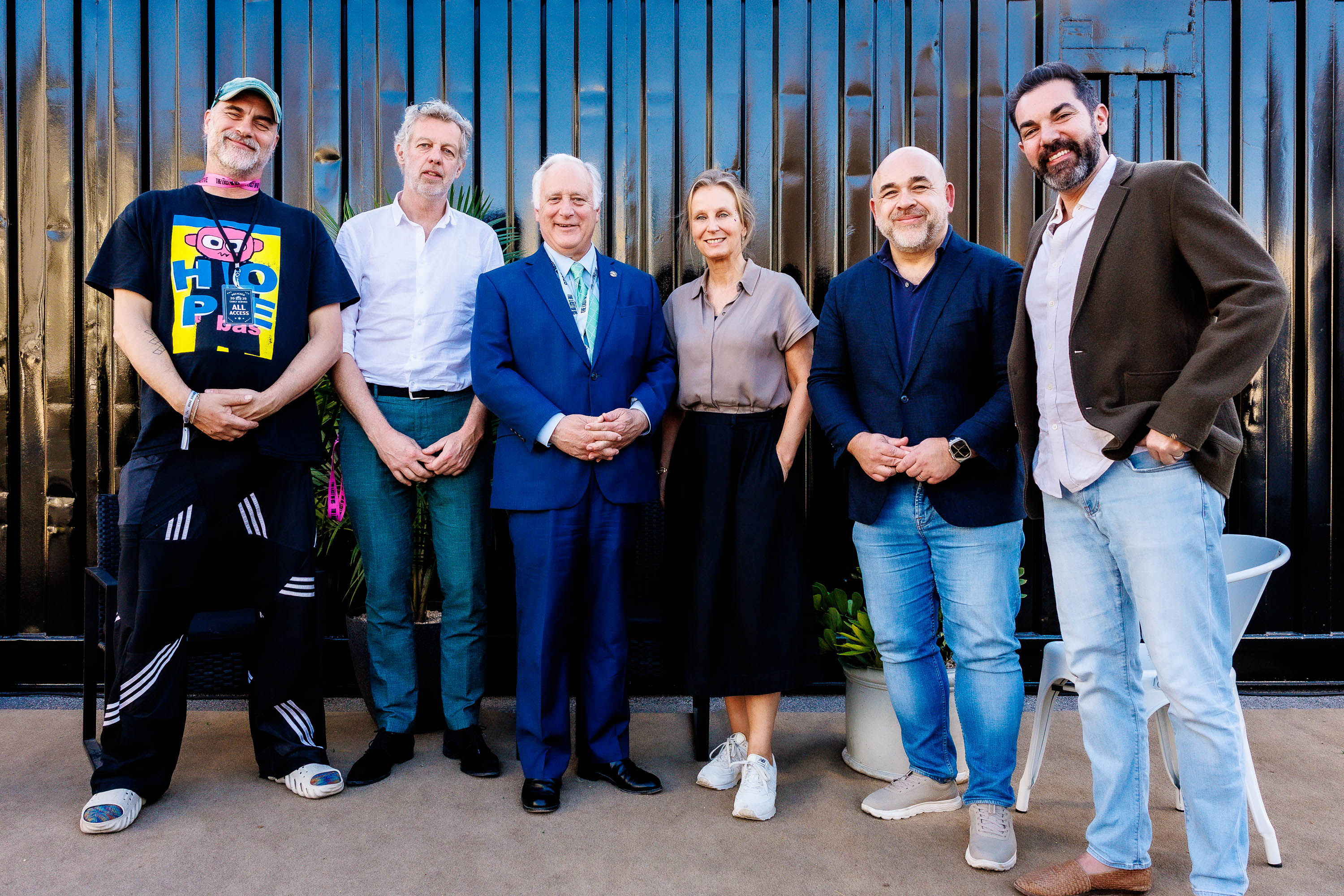
Jann de Waal (second on the left), with Barbera Wolfensberger - photo Ben Houdijk

Translating complex processes and innovative technologies into sustainable and usable products—that is my passion, my drive.

From the Amsterdam University of Applied Sciences, he was involved in the Communication and Multimedia Design (CMD) programme. This is how he became involved with CLICKNL, driven by the conviction that many creative service-oriented companies need a solid knowledge base. “Especially on the digital side, very little scientific knowledge was being used at the time,” De Waal says.

Engaging digital agencies was challenging, because the creative field was highly fragmented, but the establishment of DDA ensured that the discipline gained a solid foundation and became embedded within the creative industry.

Better board member

He looks back on his years on the Top Team as enjoyable and intellectually rewarding. “Coming from an SME, you are always operating in a service-oriented way. I found it particularly instructive to work from a different position, as a Top Team member and later as chair. You are appointed by the minister, which gives a certain level of authority. At the very least, people sometimes pick up the phone,” he says with a laugh. “I gained a very deep insight into how policy is made and how politics works. That experience enriched me. It has made me a better administrator.”

The Netherlands has a rich creative industry. We are not a single ASML, but a very broad sector, partly service-oriented and partly focused on developing its own products. De Waal explains: “For the Ministry of Economic Affairs, that was not self-evident, as they were used to working with traditional industries. The first Top Teams mainly worked to bring this to their attention, and also to make the sector itself aware of this. What our Top Team focused on was ensuring that we had the right points of entry, and that we could seize the opportunities that exist—based on the government’s objectives—and ensure they are effectively embedded within the sector.”

Jann tijdens CreativeNL Live 2023
Jann de Waal on stage during CreativeNL Live 2023 - photo Kas van Vliet

Visible and less visible achievements

In this respect, De Waal sees both visible and less visible achievements. “The most visible are the larger, high-profile programmes that people recognise from their own sub-sector, such as SXSW, CIIIC and PONT. But also the Circular by Design programme (CIRCO), which helps companies and designers engage in circular entrepreneurship through a proven method for developing circular products, services and business models, funded by the Ministry of Infrastructure and Water Management (I&W).”

As Bart Ahsmann noted earlier, the sector has been strengthened by developing knowledge together with knowledge institutions. This is the role of the Knowledge and Innovation Agendas (KIAs), such as the Agenda Power of Design.
“Through CLICKNL, we have ensured that knowledge is developed in a more targeted way, not only at universities but also at universities of applied sciences, and that this knowledge finds its way into the sector. That is less visible, because it works indirectly,”he says. “It has taken shape through various NWO/SIA schemes such as KIEM GoCI or the Mission Calls of the Knowledge and Innovation Agenda Mission-Driven Innovation. And of course through the KEMs, which are broader and aimed at all changemakers. That will continue.”

Alongside these public-facing programmes, much of the strength and impact lies in less visible initiatives that run through other parties. De Waal explains: “We deliberately chose to connect intelligently as much as possible, rather than setting everything up ourselves. We look at where a link is missing, how to position the right parties, and how to make developments move faster. We also do this through collaborations with the cultural sector and at the regional level: which partners can help an initiative land effectively? One example is CIIIC, the National Growth Fund (NGF) programme with a budget of 190 million euros. It was set up with four implementing organisations that are able to distribute large funding streams, so you don’t first spend two years building an organisation,” he says.

As a result, the entire ecosystem has become much stronger. At times, discussions narrow again due to shifting political priorities. “That means we have to make sure we don’t lose sight of where our strength lies,” De Waal believes.

We have a strong creative industry, not only in business services—such as architecture, advertising and ICT agencies—but also in creative content, including film and gaming.

CLICKNL as a catalyst

Then there are the less visible achievements: showing, at the right moment, what the sector can contribute and how to involve it. “You only really notice that in the end,” says De Waal. “We regularly take part in discussions around the major societal missions, such as healthy living, the energy transition and the circular economy. These conversations are about collaboration and making the strength of the creative industry visible. Programmes emerge from this, such as Uptempo, in which designers explored how the energy transition in the built environment could be accelerated. In that sense, CLICKNL acts as a catalyst.”

He is proud that, with a relatively small team and a compact ecosystem, many initiatives have been set in motion and sustainably anchored.

CLICKNL is firmly positioned in two areas: developing knowledge for the sector itself, and enabling that knowledge to be applied for the benefit of the Netherlands as a whole.

Jann de Waal does not see the end of the Topteam and the top sectors policy as a problem. “Shaking things up from time to time is healthy. Making choices in that process, and focusing on certain DeepTech technologies, is perfectly fine.”

His concern is that not everyone realises how deeply the creative sector is involved in everything that is done, made and produced in the Netherlands. “Through design power, you can turn something with conflicting requirements into something valuable. That value is not only aesthetic, but also technological, economic and societal. We take up new technologies and translate them into applications that people actually want to use.”

The power of design

Designers are able to translate creativity and imagination, through a design process, into applications in which technology takes on meaningful value. “That is what we are good at, and what is taught in strong and broad design education programmes,” he says. “You find these designers in start-ups, corporates and within government. Precisely because they are so widely spread, there is a risk that their collective voice becomes less audible and that the importance of design power in the Netherlands and Europe is underestimated — especially in these geopolitical times, when the challenge goes beyond the blind application of technology. Designers can play a key role in strategic autonomy, economic resilience and the transitions that are needed.”

SXSW-photo-Ben-Houdijk
Jann de Waal during SXSW 2025 - photo Ben Houdijk

It is precisely within collaborations and value chains, where designers are part of multidisciplinary teams, that the application of design power leads to tangible results in addressing complex societal challenges. De Waal agrees with Barbera Wolfensberger that some ministries rely too heavily on the idea that investing sufficiently in technology will solve everything.

It is not either technological innovation or societal innovation. They are intertwined, and every design choice you make has an impact on people’s lives.

Accelerating transitions

“Precisely where design power leads to transformative applications, there is still a blind spot in economic policy,” he argues. “By combining fundamental technology with transformative propositions, societal challenges can be addressed — for example in food systems, mobility and housing. With the Knowledge and Innovation Agenda Societal Earning Capacity, we have taken the first steps and established a knowledge base for this. Design power can make a major contribution to accelerating transitions and to earning capacity.”

Because there is often no existing market for these kinds of applications, a different approach is needed, he explains: forward-thinking entrepreneurs, designers who can develop in iterative cycles, and financing or an innovative government willing to embrace this. “At policy level, this deserves more attention; it costs relatively little and delivers a great deal,” he says. “My drive is to give this an extra push, one way or another.” Together with Bart Ahsmann, he is discussing this with the Ministry of Economic Affairs.

In closing, De Waal addresses the new generation: “I am optimistic. I see many motivated, well-educated and eager-to-learn young designers. Keep learning and keep deepening your knowledge. Even though the profession will change through AI and the challenges will not become simpler, creative and intelligent designers will remain indispensable.”

And to CLICKNL, he adds: “Keep strengthening the sector. Keep developing strong programmes that work on two levels: for the sector itself and for the Netherlands as a whole. And keep emphasising to creative partners that collaboration pays off many times over.”

Text: Viveka van de Vliet
Image: Ben Houdijk, Kas van Vliet