Top sector policy and top team to be discontinued

CLICKNL continues the movement

The current top sector policy and top team will cease to exist on January 1, 2026, but TKI CLICKNL will continue with undiminished enthusiasm. It will continue to play a crucial role as a connector in the “golden triangle” of businesses, knowledge institutions, and government, with a mission-driven cross-sectoral approach for a broader target group than the creative industry. “We will continue to play an important role in driving innovation through Public-Private Partnerships (PPPs) in the Mission-driven Innovation Policy as coordinator of the Knowledge and Innovation Agenda Mission-Driven Innovation (KIA MV),” says CLICKNL director Bart Ahsmann.

This shifts CLICKNL's role for the Ministry of Economic Affairs from a focus on the sector to one of realising societal and economic impact. At the same time, the creative industry remains a crucial sector for CLICKNL, both within the ministry and for the Ministry of Education, Culture and Science.

  • The name ‘Top Sector’ will disappear and the management model will change, but industrial and innovation policy will continue.

    Bart Ahsmann, Director of CLICKNL

  • Bart Ahsmann 2025 vierkant

CLICKNL is a key player in the creative industry. With CLICKNL, the sector now has strong organizational capacity, an important voice, and works closely with the Ministries of Education, Culture and Science and Economic Affairs. CLICKNL has become an essential connector that cannot be ignored. In this way, the top team has made itself redundant," says former top team member, Chief of Science Paul Hekkert. Bart Ahsmann agrees: “The name ‘Top Sector’ is disappearing and the management model is changing, but industry and innovation policy will continue. It is understandable that after fifteen years, different strategic choices are being made. After all, everything has a lifespan. We can continue to maintain our important position even without the Top Sector policy.”

Creative capacity and design power

The changes give Bart Ahsmann (director of CLICKNL) the opportunity to look at the most important successes achieved, the challenges, and the future.
Although the power of the creative industry has been frequently mentioned and proven, it remains a challenge, according to the director. The Ministry of Economic Affairs is well aware that the creative industry is a sector of economic importance, but as Barbera Wolfensberger, former figurehead of the top team and DG Culture and Media at the Ministry of Education, Culture and Science, says: ‘It is important that we continue to engage in dialogue with the Ministry of Economic Affairs to emphasize the power of the creative sector’. Ahsmann considers this a good adage. “We must continue to focus on the creative sector as an indispensable link in tackling complex and major social challenges, whereby its creative capacity and design power make an essential contribution to those tasks and to increasing societal and economic impact.”

  • We must continue to emphasize the power of the creative sector

    Barbera Wolfensberger, former figurehead of the Top Sector Creative Industry and Director-General for Culture and Media at the Ministry of Education, Culture, and Science

  • Barbera Wolfensberger SXSW

He is optimistic that OCW endorses the importance of CLICKNL in the field of knowledge and innovation. “The role we have to play will become increasingly important. We will take a closer look at how we can position ourselves as a neutral link in the middle in order to work better together and achieve greater synergy between all the organizations involved. We need to forge alliances between departments and financiers in order to strengthen the focus on research and innovation.”

Cross-sectoral collaboration

Ahsmann highlights a few developments from recent years that he considers crucial, such as the integrated, cross-sectoral approach to the sector. “I am glad that we have abandoned silo thinking. Not only is it impossible to develop any product, fashion item, or digital tool without other disciplines, but the challenges we face are so great and complex that they span multiple disciplines and therefore require cross-sectoral collaboration.”

I am glad that we have abandoned silo thinking

Parallel to the launch of the mission-driven innovation policy, the KEM agendas (2020-2024 and 2024-2027) and the cross-sectoral Knowledge and Innovation Agenda Mission-Driven Innovation (KIA MV) (2020-2023 and 2024-2027) should not go unmentioned, according to the director. “This has given a boost to knowledge development and the sector's involvement and interest. Missions fit like a glove with the part of the sector that uses design power as expertise,” says Ahsmann. Professionals can use the eleven specific Key Enabling Methodologies and techniques that have been identified together with experts to structure innovation processes. “The great thing is that it works much more broadly: all change professionals within knowledge institutions, the business community, and public-private partnerships can use the methods to give structure and direction to change,” adds Paul Hekkert.

CIIIC: largest innovation program for the creative industry ever

These agendas have formed the basis for wonderful and large-scale programs. A golden opportunity, because they have helped to stimulate programs from CLICKNL, build them ourselves, and work cross-sectorally. Good examples are the PONT program (about designing with and in the public sector) and, in particular, the Creative Industries Immersive Impact Collation (CIIIC) program, which aims to strengthen the industry in the field of Immersive Experiences (IX).

CIIIC
CIIIC, or Creative Industries Immersive Impact Collation, was launched - photo Ben Houdijk

  • Because the top team had close ties with OCW and EZ, we were able to shape and strengthen cooperation between the government and creative professionals on major social challenges, whereas previously it had been difficult for these parties to reach each other.

    Captain of Science, Paul Hekkert

  • Paul Hekkert

To give the Netherlands a leading position in this international development, the Ministries of Education, Culture and Science and Economic Affairs launched the largest innovation program ever in this field from the National Growth Fund, with substantial funding of two hundred million euros. “Because the top team had close ties with OCW and EZ, we were able to shape and strengthen cooperation between the government and creative professionals on major social challenges, whereas previously it had been difficult for these parties to reach each other,” Hekkert cites as an important achievement. Ahsmann adds: "Since the first CRISP program (ten million), we have seen an exponential increase. I am extremely proud that we have succeeded in this. It would never have been possible without the top team."

By the end of 2027, NWO/SIA will have invested approximately 120 million euros over a period of fifteen years in research into the knowledge base for tackling societal missions.

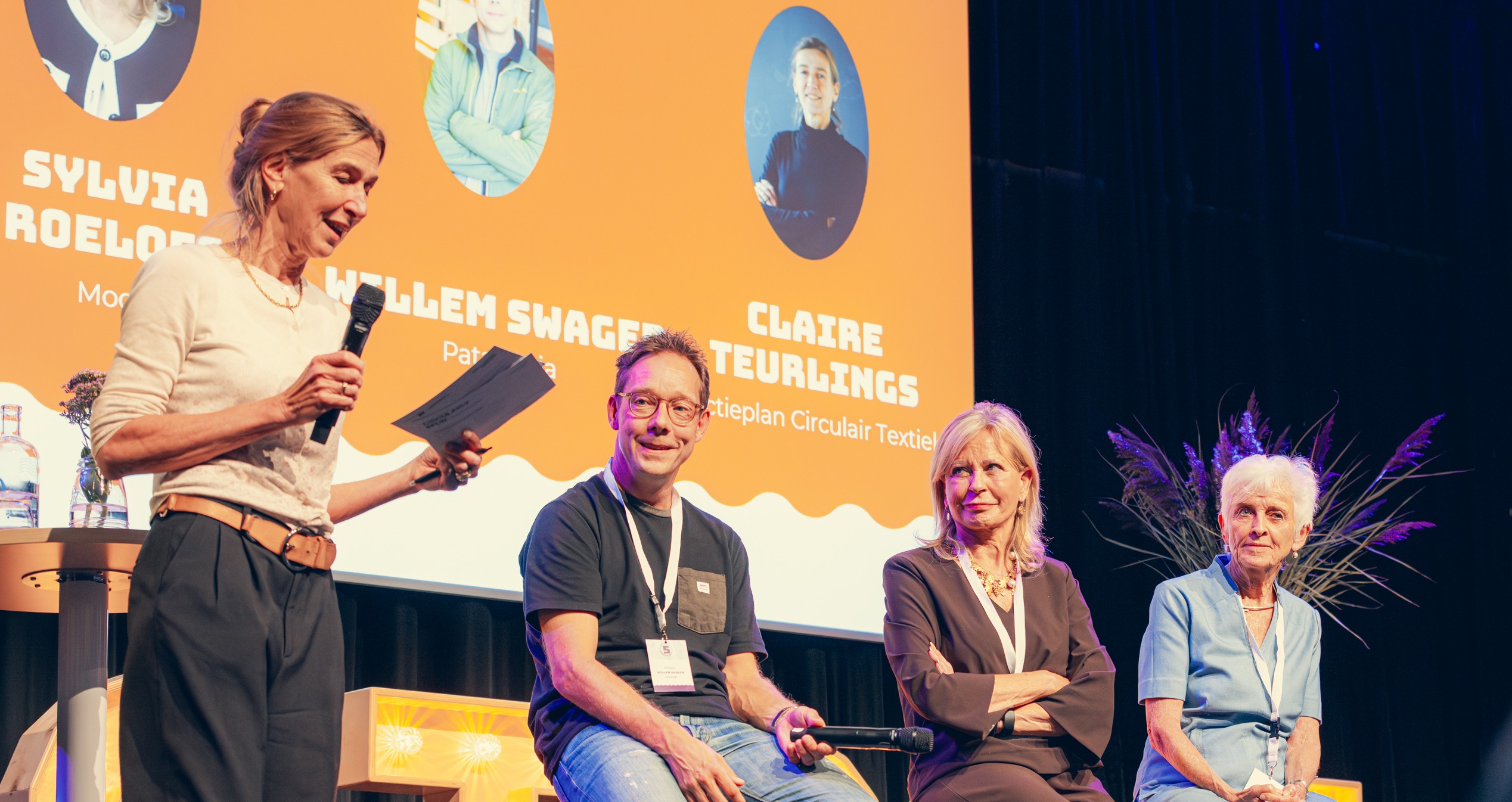
“This development has also led to greater confidence among research funders NWO and SIA. They have ensured continuous and steadily growing funding,” says Ahsmann. "By the end of 2027, NWO/SIA will have invested around 120 million in research for the knowledge base for tackling missions, over a period of fifteen years. The upward trend in generating public-private partnerships until 2024 is a harbinger of increasing success in developing large programs, the director believes. And that continues: a new important program is the Circular Textiles Action Plan (ACT), which aims to make the textile, clothing, leather, and footwear chain more sustainable by stimulating collaboration and innovation.
ACT op CTD 2025
During Circular Textile Days 2025, the Circular Textile Action Plan was officially launched - photo Robert de Groot

Green lights

The policy after 2027 will be further developed in the coming years and is still uncertain. Partly because of this, we do not know how the creative industry can be sustainably embedded in our country's industrial and innovation policy. However, it is telling that the cabinet positions design power as an economic necessity. Ahsmann: “In terms of content, all signals are green, so let's continue to take advantage of that and strengthen it. We are at the forefront at the European level, and the sector can be a leader internationally. My ambition is to utilize the Netherlands as a large field lab by entering into knowledge-driven collaborations worldwide, whereby we export knowledge and learn from each other.”

It is telling that the cabinet is positioning design power as an economic necessity

Together with the Creative Industries Top Team, we have demonstrated that collaboration between designers, researchers, businesses, and government yields concrete innovation. “That is extremely valuable. We will continue that development.”


Text: Viveka van de Vliet

  • We would like to thank the members of the Top Team, the indispensable support staff, and all our predecessors over the past 14 years for their dedication, enthusiasm, and energy.